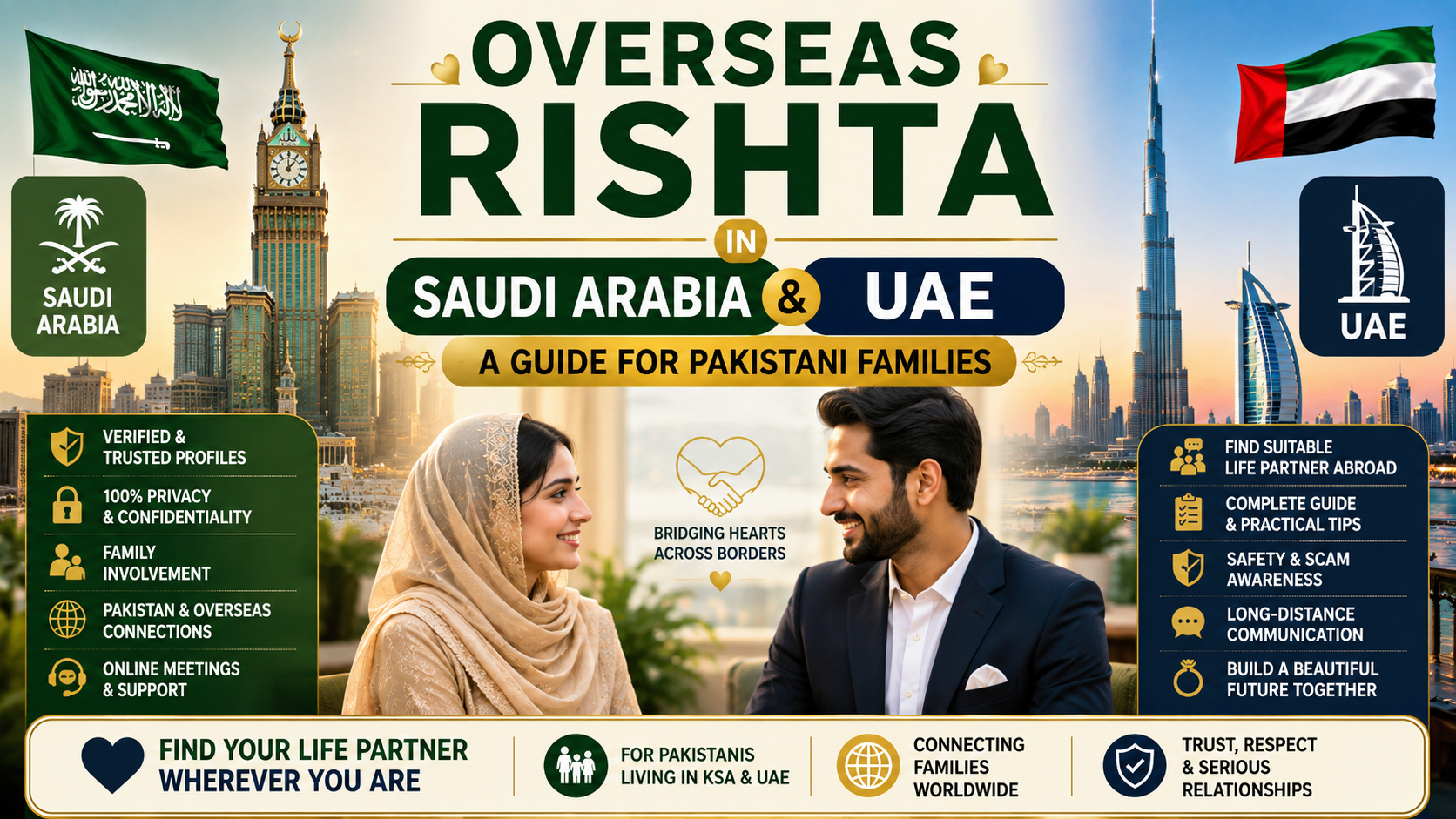
For many Pakistani families, the search for a rishta no longer ends at the city or the biradari. A large part of our community lives and works in Saudi Arabia and the UAE, and families on both sides increasingly look across the Gulf for a suitable match — sometimes for a son settled in Riyadh, sometimes for a daughter whose relatives are in Dubai.
That search brings real advantages and real complications. Distance makes it harder to verify what you are told and easier for the wrong people to misrepresent themselves. This guide covers how families approach an overseas rishta sensibly — where serious proposals come from, what to check, and where things commonly go wrong.
Quick Answer
Serious overseas rishta connections usually come through family and community networks, respected acquaintances in the Gulf, or established matrimonial platforms — not through strangers messaging privately. Whatever the source, verify identity and documents independently, involve elders on both sides early, discuss residency and future living arrangements honestly, and never send money to someone you have not properly verified.
Why families look overseas
The reasons are practical rather than aspirational. Many families already have relatives in the Gulf, so the social circle extends there naturally. Others feel a match settled abroad offers a steadier financial start. And for Pakistani families already in Saudi Arabia or the UAE, the pool of suitable local matches can be small, which makes reaching back to Pakistan the obvious route.
One honest caution: an overseas rishta is not automatically a better rishta. Living abroad says nothing about character, real financial position, or how someone will treat a spouse. The same care applies as at home — with extra checks, because distance hides more.
Rishta considerations for Saudi Arabia
Saudi Arabia hosts a very large Pakistani expatriate population, concentrated in cities like Riyadh, Jeddah and Dammam. Community life often centres on workplaces, neighbourhoods and mosques, and rishta introductions usually move through those same circles. A few things to think through carefully:
- Residency and sponsorship. Bringing a spouse depends on visa category, employer and salary level. Do not assume a family visa is automatic — ask directly and expect a clear answer.
- Where the couple will actually live. Many expatriates support families back home while living in shared accommodation abroad. Whether the wife will join him, and when, must be settled before the nikah.
- Job security. Employment abroad is often tied to a single contract; the nature of the work matters more than the fact that it is overseas.
- Legal formalities. Marriage procedures and documentation for foreign nationals differ from Pakistan and can change. Confirm current requirements with the Pakistani embassy or consulate and the local authorities.
Rishta considerations for the UAE
The UAE, particularly Dubai, Sharjah and Abu Dhabi, has a large and long-settled South Asian community. Families here are often second-generation residents, which changes the conversation — expectations may sit somewhere between Pakistani and Gulf-raised norms, and that is worth discussing openly rather than assuming.
Similar practicalities apply: sponsoring a spouse depends on visa status and income, and living costs in the larger emirates are significant. The UAE government’s portal sets out the framework for marriage procedures in the UAE — a better starting point than second-hand advice, since requirements are updated from time to time.
Because the expatriate community is so mixed, families sometimes assume more shared background than exists. A family settled in Dubai for thirty years may hold quite different expectations about work, mobility and household arrangements than a family in Sialkot. Neither is wrong — but the difference should be discussed.
Where serious proposals actually come from
Family and community networks
Still the most reliable source: someone in the chain knows the family personally and their own reputation is attached to the introduction. Tell relatives in the Gulf plainly what you are looking for — vague requests produce nothing, specific ones travel.
Mosque and community circles abroad
Expatriate communities have informal networks where families quietly share that a son or daughter is looking. Respected elders, welfare associations and long-standing family friends often play this role — slower than an app, but the background checking is largely done for you.
Online matrimonial platforms
Matrimonial websites and apps are now a normal part of the search, and there is nothing improper about using them. They widen the pool considerably across countries.
What they cannot do is vouch for anyone. Treat any verification badge as a starting filter, not proof — every claim on a profile still needs independent confirmation. Be equally cautious of anyone promising guaranteed matches or demanding large upfront payments.
The role of the family
In an overseas rishta, family involvement is not just tradition — it is a practical safeguard. Elders on both sides can speak directly, ask questions young people find awkward, and notice inconsistencies. Where the families cannot meet in person, a trusted relative or friend in the same city can visit and report back honestly — a single step that prevents most of the problems described below.
Involvement should not become pressure, though. Both the prospective bride and groom must give free, informed consent, and both need space to ask questions and to say no. A rishta someone has to be talked into is not a good foundation, wherever it is arranged.
Compatibility beyond the biodata
Biodata covers age, education, caste, height and salary. Almost nothing that determines whether a marriage works is on it. Worth discussing before proceeding:
- Where the couple will live, and how long apart if the visa takes time.
- Whether the wife intends to work or study, and whether both families accept it.
- Financial responsibilities to parents and siblings on both sides.
- Religious practice and expectations around it, which differ widely even between practising families.
- Living arrangements — joint or separate, in Pakistan or abroad.
- Long-term intentions: settle in the Gulf, return to Pakistan, or move elsewhere.
These conversations are uncomfortable — far less so than discovering the mismatch a year into the marriage.
Talking across distance
When families are in different countries, most communication happens over calls and messages, and it is easy to form an impression that does not match reality. Keep conversations within limits both families are comfortable with, involve family members in some of the calls, and use video rather than text — faces and voices reveal more than typed messages.
Be wary of anyone who consistently avoids video calls, refuses to let their family speak to yours, or gives shifting explanations for why a meeting is impossible.
Verification: confirming who you are dealing with
This is the step families most often skip, and the one that matters most across borders.
- Confirm identity documents — CNIC or NICOP, passport, and Iqama or Emirates ID. A serious family will not take offence.
- Verify employment independently. A company name is checkable; a salary claim is not.
- Confirm marital history. A NADRA Family Registration Certificate reflects family composition on record; Pakistan’s Ministry of Foreign Affairs explains the NADRA services available through Pakistani missions abroad.
- Send someone to visit — a relative or trusted friend in the same city. Nothing replaces a person who has stood in the family’s home.
- Cross-check what you are told against what others in the community say.
Privacy and personal safety
Share information gradually, in proportion to how far the discussion has genuinely progressed. Early on there is no reason to hand over home addresses, identity documents, financial details or family photographs, and personal photos should not circulate through informal groups. If a conversation feels wrong, disengage without explanation.
Warning signs of matrimonial scams
Overseas rishta searches attract fraud because families are hopeful and verification is hard. Common patterns:
- Any request for money. Visa fees, medical emergencies, travel costs, “processing charges”, customs on a gift — the single clearest warning sign.
- Refusal to video call or to let families meet, with endless reasons.
- Unusual haste — pressure to fix the nikah before families have properly met or verified anything.
- An impressive but unverifiable profile: a large salary, a senior post, no checkable employer.
- Secrecy, especially requests to hide the contact from family.
- Requests for identity documents or bank details early on.
If you have been targeted, stop contact and preserve the messages. In Pakistan, online fraud can be reported to the National Cyber Crime Investigation Agency; families abroad should also inform local authorities.
A checklist before moving forward
- Both families have met, in person or by video, with elders present.
- Identity documents seen and consistent.
- Employment and residency status explained clearly.
- Marital history confirmed and undisputed.
- Someone trustworthy has visited the family in person.
- Living arrangements after marriage agreed, not assumed.
- Both the bride and groom have given free, unpressured consent.
- No money has changed hands outside normal, transparent arrangements.
- Legal and documentation requirements confirmed with the relevant embassy or authority.
FAQs
Is it safe to look for a rishta online?
It can be, provided the online contact is only the introduction and everything after it is verified offline through families. The risk comes from treating a profile as proof.
Can a Pakistani working in Saudi Arabia or the UAE bring a wife immediately?
Not always. Sponsoring a spouse depends on visa category, employer and income, and the rules differ between the two countries and change over time. Ask for specifics and confirm with the relevant authorities.
How do we verify someone living in another country?
Through documents, an independent check of the employer, and — most importantly — a trusted person who can meet the family in person.
Is it acceptable to say no after initial discussions?
Yes. Withdrawing respectfully before commitment is entirely normal, and far better than proceeding with doubts.
Where to start
Begin with the people who already know you. Tell relatives and trusted contacts in Saudi Arabia or the UAE exactly what your family is looking for, and let matrimonial platforms widen that search rather than replace it.
Then slow down where most families rush: verification. Confirm identity and residency, send someone to meet the family, and talk honestly about where the couple will live and what each side expects. An overseas rishta arranged carefully, with both families involved and both young people freely consenting, is no riskier than one arranged at home. The danger lies almost entirely in skipping the checks that distance makes necessary.