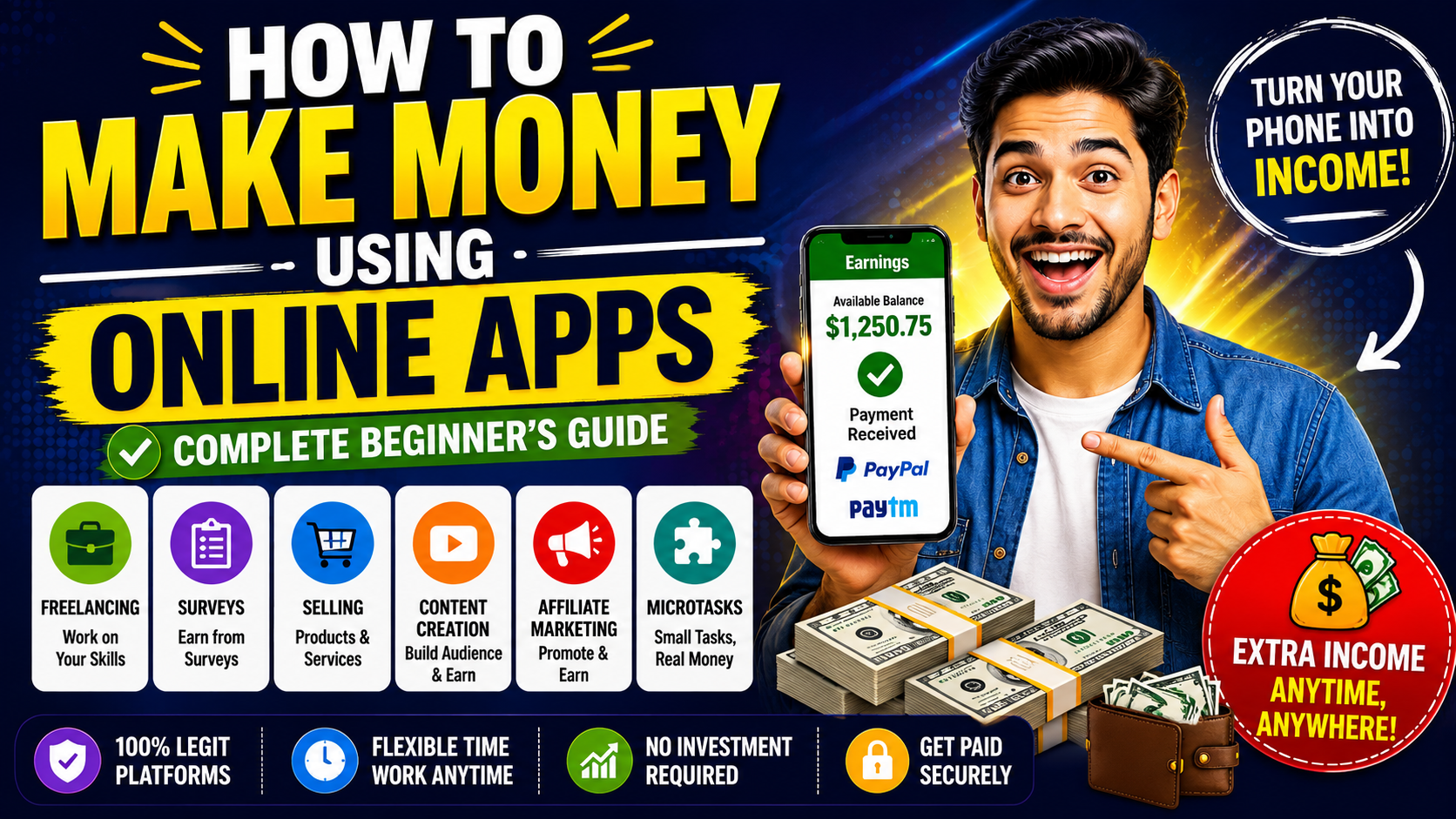
Plenty of people earn real money through apps on their phone. Plenty of others download a dozen “earning apps”, spend a week tapping, and end up with nothing — or worse, hand over money they never get back.
The difference is almost never the phone. It is knowing which categories of app-based work actually pay, what each demands from you, and how to tell a real platform from one built to take your data or your deposit. This guide walks a beginner through the legitimate options, how each one works, and the warning signs to learn before you sign up for anything.
Quick Answer
Most genuine app income comes from a few categories: freelancing, selling products or services, content creation, affiliate marketing, and microtasks or research studies. Each pays for a skill, an item, an audience or your time. Earnings vary enormously, nothing is guaranteed, and any app that asks you to pay before you can withdraw is not one of them.
What app-based earning realistically looks like
One honest framing first. Apps are a distribution channel, not a source of money. Something of value still has to change hands — your skill, your time or a product someone wants.
Results therefore depend on your skills, your market, the time you can commit and some luck with timing. Two people using the same app can have completely different outcomes. Anyone showing a screenshot of guaranteed daily income is selling something — treat every income figure you see online as a claim, not a fact.
Most beginners start small. The first goal is not replacing a salary — it is completing one paid task, one sale or one client, and learning what that actually involves.
1. Freelancing apps: getting paid for a skill
Freelance marketplaces connect people who need work done with people who can do it. Writing, graphic design, video editing, translation, data entry, voiceover, social media management and web development are all common categories.
The mechanics are consistent across platforms. You build a profile, list what you do, either apply to posted jobs or publish a fixed-price service, and the platform holds the client’s payment until the work is delivered. That escrow step protects you, which is why it is worth keeping work and payment on the platform early on.
The hard part is the first few jobs, because you have no reviews yet. Narrow your offer instead of listing everything you can do, price sensibly at first, and treat early jobs as reputation-building. Communication and deadlines get you rehired more often than raw talent does.
2. Selling products or services
Selling apps split into a few different shapes:
- Resale. Local marketplace apps let you list things you already own. It is the fastest way to see money move, and the lowest risk, because you are not buying stock first.
- Handmade or physical products. Craft and marketplace apps handle listings, payment and sometimes shipping labels, in exchange for fees.
- Digital products. Templates, presets, printables and e-books are made once and sold repeatedly, though they take real effort upfront.
- Local services. Booking and gig apps connect tutors, repair workers, cleaners and drivers with nearby customers.
Whatever the shape, read the fee structure before you list. Listing fees, commission, payment processing and shipping all come out of the price you see, and a listing that looks profitable can quietly lose money once they are counted.
3. Content creation
Content is the slowest of these to pay and the one people most often misjudge, but it has the highest ceiling.
Income arrives from several directions: platform monetisation once you meet the eligibility thresholds, brand partnerships, and audience-funded options like tips or memberships. Most creators who earn anything meaningful combine two or three of these rather than relying on ad revenue alone.
The practical entry point is picking one platform and one topic, then publishing consistently for months rather than weeks. Editing is where most beginners get stuck, and the right software removes a lot of that friction — our roundup of AI tools for video creation covers options that work on a modest setup. When brands do start approaching you, it helps to understand how they find creators in the first place, which is what these influencer marketing platforms are built to do.
4. Affiliate marketing
Affiliate marketing means recommending a product with a tracked link and earning a commission when someone buys through it. Programmes are run by individual brands and by large networks, and commission rates differ enormously by category.
It works when you already have somewhere to put the links — a blog, a channel, a newsletter, an active social account. It does not work as a first step, because links posted where nobody is reading earn nothing. Recommend only what you have actually used, and disclose that a link is an affiliate link, which most regions require.
If a blog is your route, search visibility is the whole game, and these AI tools for SEO can help a beginner find topics worth writing about.
5. Microtasks, surveys and research studies
These pay for your time rather than a skill: short data-labelling jobs, app testing, transcription snippets, market research surveys and academic studies.
Be clear-eyed about the pay. Rates are usually low, many surveys screen you out partway through, and payouts often sit behind a minimum threshold. This is pocket money for dead time, not a plan.
This category also attracts the most impersonation. The FTC has warned about a sharp rise in so-called task scams, where people are asked to complete simple repeated tasks and then to deposit their own money to keep going. Legitimate task work never requires a deposit.
How to spot a fake earning app
Most fraudulent earning apps share the same handful of traits. Any one of these is reason to stop:
- You have to pay to get paid. Activation charges, “withdrawal fees”, membership upgrades to unlock earnings — this is the single most reliable sign of a scam.
- The promised returns are specific and generous. Fixed daily earnings for minimal effort do not exist.
- Earnings depend on recruiting people. If your income comes from who you invite rather than what you do, it is a referral pyramid.
- It is not in the official app stores, or you are asked to sideload an APK from a link.
- It wants too much, too early. Bank details, ID documents or card numbers before you have completed any work.
- The reviews look manufactured. Hundreds of short five-star reviews posted within days, and support that is a chat account rather than a company.
Before installing anything, search the app’s name alongside words like “scam” or “not paying”, check whether a real registered company stands behind it, and read the payout terms. The FTC’s guidance on spotting job scams applies almost directly to earning apps.
Practical tips for beginners
- Pick one method and give it 60 days. Spreading yourself across six apps guarantees you get nowhere in all six.
- Set up two-factor authentication on any account connected to a payout method.
- Never share verification codes, whatever reason is given.
- Keep records of what you earn. Depending on where you live, app income may be taxable, and reconstructing a year later is miserable.
- Withdraw regularly rather than letting a balance build inside a platform you have not tested yet.
FAQs
Which method is best for a complete beginner?
Selling something you already own, or freelancing a skill you already have. Both produce a real result quickly, which teaches you more than months of theory.
Can I start with no money at all?
Yes. Freelancing, resale, content creation and microtasks all start at zero cost. Anything that requires payment upfront to begin earning deserves suspicion.
How much can I realistically earn?
There is no honest number. It depends on your skill, your market, your hours and your consistency. Anyone quoting a guaranteed figure is advertising, not informing.
Are survey apps worth the time?
Only as filler. The pay per hour is low and screening wastes time, so treat them as loose change rather than a strategy.
Is it safe to give an app my bank details?
Only once you have verified the company is real and you have earned something to withdraw. Never at sign-up, and never a card number for a platform that is supposed to pay you.
Where to start
Making money through apps is ordinary work delivered through a screen. Pick the category that matches what you already have — a skill, some items, spare time, or an audience — and put your effort into one place long enough to see whether it works.
Assume nothing is guaranteed, verify any platform before handing over personal or financial details, and walk away from anything that asks you to pay first. If you want more walkthroughs in this style, our How To guides cover the tools and setups that make this kind of work easier.